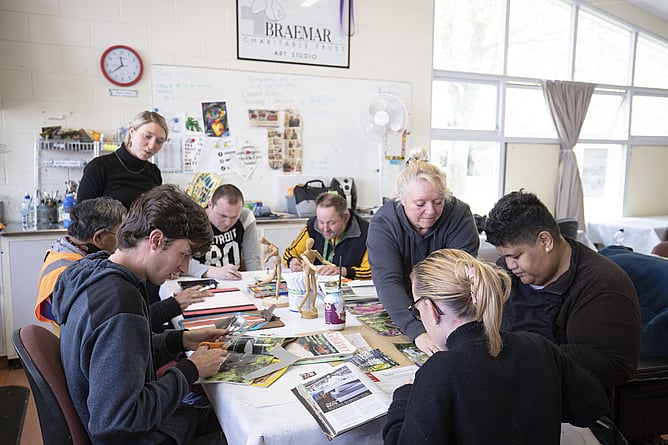
On any given day at Arts for Health, you might see someone quietly painting in the corner, another laughing over a shared idea, and someone else simply sitting with a cup of tea, taking a breath.
People come in carrying all sorts of things. Stress. Loss. Isolation. Uncertainty.
They don’t always talk about it straight away. Sometimes they don’t need to.
Instead, they pick up a brush.
Over time, something shifts.
We have seen this for years. People return. They stay longer. They begin to talk. They begin to smile more easily.
But we wanted to be sure.
Was this something we were interpreting, or was it something people were actually experiencing for themselves?
So in 2025, we partnered with Abby Parsons from the University of Waikato to carry out an independent evaluation of our programmes.
📄 Read the full research: Click here
Starting with a simple question
We didn’t want to measure success in a clinical way. We wanted to understand real experience.
What changes for people when they come here?
What stays the same?
What actually matters?
Participants were not given categories or expectations. They were simply asked to describe their experience in their own words.
What people described
The answers were not complicated.
They were honest.
Many people talked about arriving with a heavy mind and leaving feeling lighter:
“I normally feel heavy when I arrive… but as I paint, I feel the burdens lessen and my mind relaxes.”
Others spoke about something just as important. Not being alone.
When I come here I feel welcome and relaxed and have a lot of new friends.”
There were quiet moments of confidence too. Not loud or dramatic, just steady:
“I’m a creative artist. I plan to do things I haven’t done before.”
And then there were the moments that sit deeper than anything we could measure:
“My wife died seven years ago. That’s why I come here. I make art every day.”
That is not about art as an activity.
That is about art as something to hold onto.
What we began to understand
Across all of the responses, a pattern appeared.
People were not just talking about making things.
They were talking about how they felt while they were here, and who they were able to be.
Some described finally finding people who understood them:
“Outside of here I don’t have many creative friends. Here people get it.”
Others described the freedom of not needing to explain themselves at all.
There is no pressure to perform. No expectation to be a certain way.
You can talk, or not talk. Share, or not share.
That space, simple as it sounds, matters more than we realised.
What this tells us
The research confirmed something we had been seeing quietly over time.
Arts for Health is not just a place to make art.
It is a place where people:
feel accepted without needing to explain why
connect without pressure
express what is difficult to say
slowly rebuild confidence in themselves
For some, it becomes part of their routine.
For others, it becomes part of how they cope.
One participant said it in the simplest way possible:
“I love the way I feel after leaving.”
That feeling is not something we create.
It is something that grows in the space, between people, over time.
Why this matters
Life can be busy, loud, and demanding. Many people move through it without a place to pause.
Creative spaces offer something different.
They give people time.
They give people room.
They give people a way to reconnect with themselves and others.
This research shows that these experiences are not incidental.
They are consistent, and they are meaningful.
Where to from here
This evaluation did not tell us to change direction.
It reminded us to stay steady in what we are already doing.
To keep the space open.
To keep it welcoming.
To keep listening.
Because at the centre of all of this is something very simple.
People need places where they can come as they are.
And sometimes, all it takes is a table, some paint, and a space that says quietly:
You are welcome here.